Ordered Mesoporous Materials via Nano-Building Block Approach.
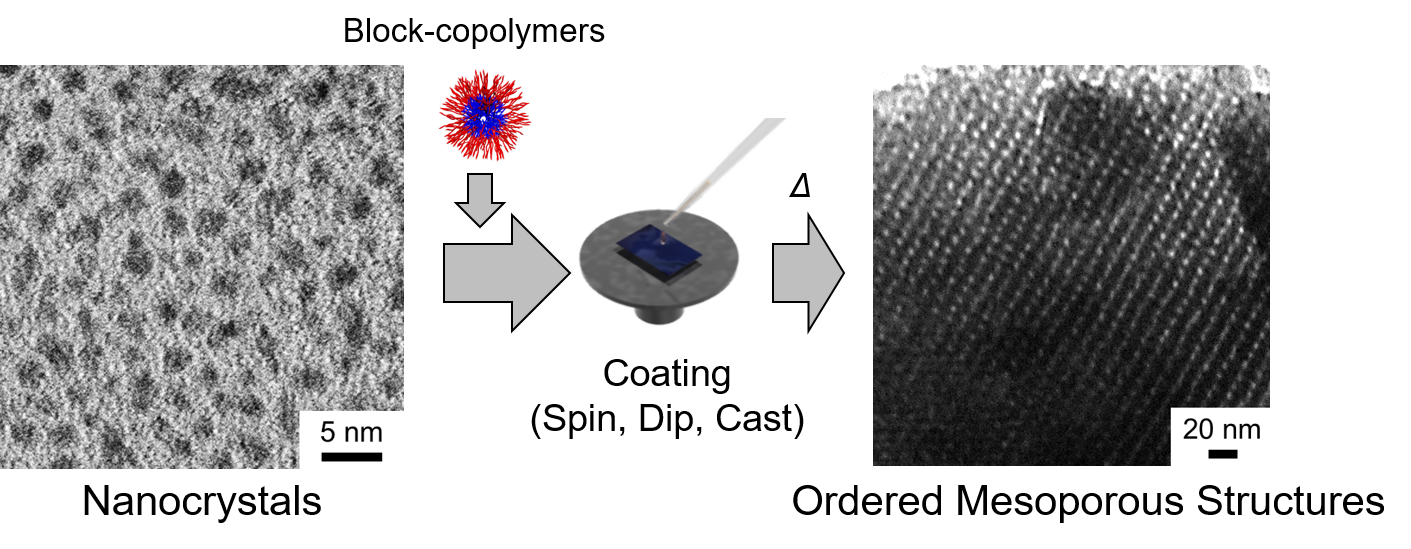
Ordered mesoporous materials have been synthesized using molecular/ionic precursors as starting materials and surfactants/block-copolymers as templates, in general. Instead of molecular/ionic precursors, single-nm-scale nanoparticles were employed as nano-building blocks (NBBs) towards synthesis of ordered mesoporous materials. The NBB approach allows synthesis of “crystalline” and “mesoporous” materials, which is difficult to obtain through conventional molecular approach. We have first reported to synthesize single-nm-scale layered hydroxide crystals and their use as NBBs towards ordered mesoporous structures. Subsequent studies focus on the size effect of both NBBs and template block-copolymers and functional improvement of hydroxide materials by introducing the mesoporous structures.
Nanoscale 2021; J. Phys. Chem. B 2021; J. Sol-Gel Sci. Technol. 2019; Chem. Mater. 2019; Chem. Mater. 2016
Synthesis of Highly Functional Nanoparticles.
Generally, nanoparticles show high specific area, which gives benefits toward applications utilizing surface functions. In the case of layered hydroxides showing functions such as electrochemical activity and catalytic property, nanoparticulate design enables to maximize using intrinsic functions. In our study, electrochemical response of Ni and Co-based layered hydroxide nanoparticles/nanocomposites and activity of Ni-Al-based layered hydroxide nanocatalysts have been studied.

Colloids Surf. A 2021; Sci. Rep. 2021; J. Mater. Chem. A 2019.; ACS Nano 2016
Meso/macroporous Monoliths Composed of Nanomaterials.
Although nanomaterials show unique functions different from bulk materials, it is hard to handle nanomaterials directly due to their small size. It is expected to synthesize structured bulk materials, such as porous materials, composed of nanomaterials for handling towards applications. We have developed synthetic methods of pore size controllable meso/macroporous monoliths composed of layered hydroxide nanoparticles/nanosheets through controlling assembly behavior of nanoparticles/nanosheets by tuning interaction and/or using surface modifiers.
Langmuir 2021; Langmuir 2016; RSC Adv. 2015; RSC Adv. 2014; J. Mater. Chem. A 2013
3D Printing Based on the Interconnection of Organic–Inorganic Hybrid Nanoparticles.
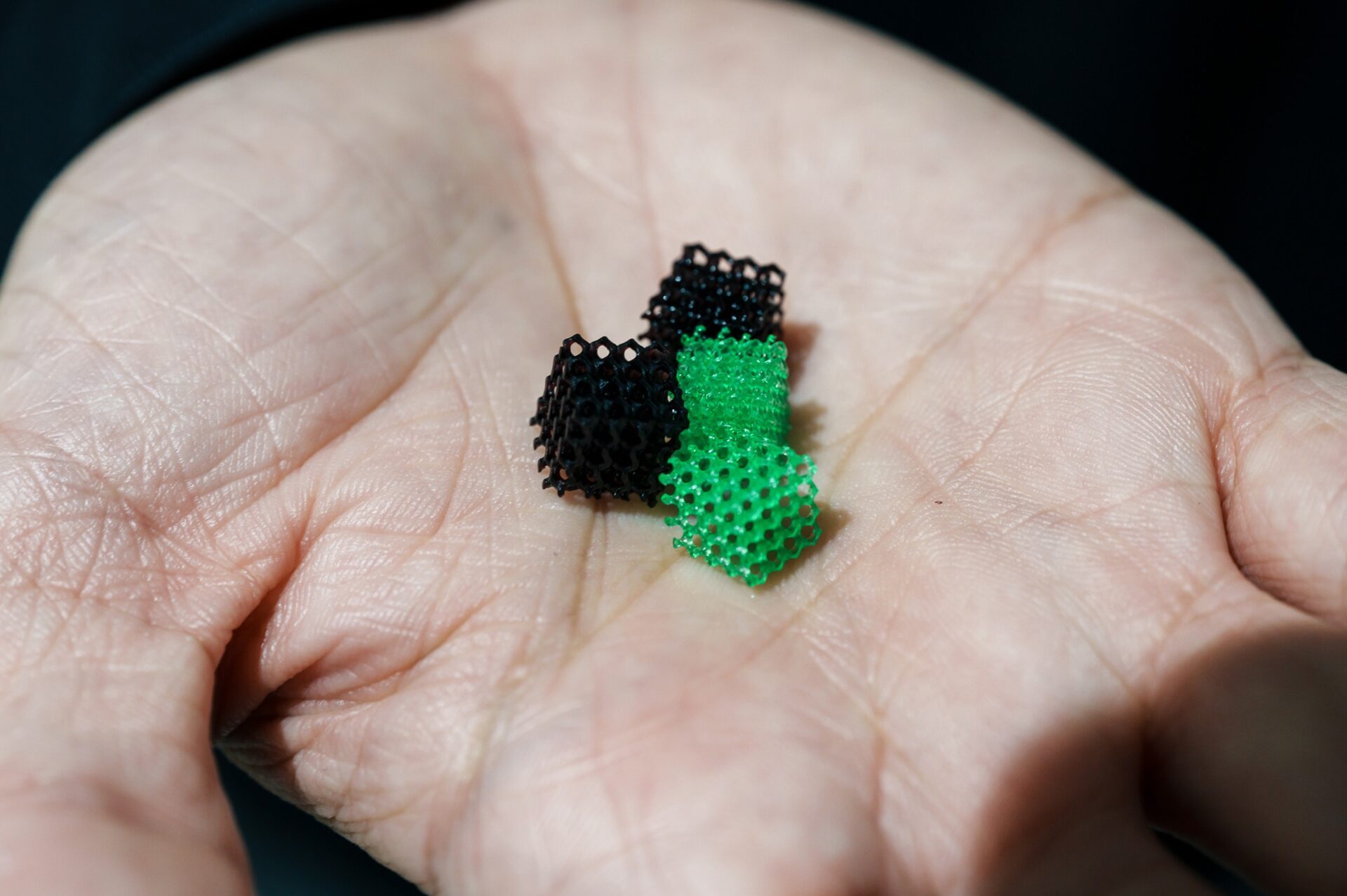
In recent years, the use of 3D printing based on additive manufacturing technologies has been expanding rapidly. Various types of 3D printers are now commercially available; among them, photopolymerization-based 3D printers are widely accessible, with many models being sold at affordable prices of only several tens of thousands of yen. Traditionally, this light-irradiation method has been limited to the fabrication of resin-based objects.
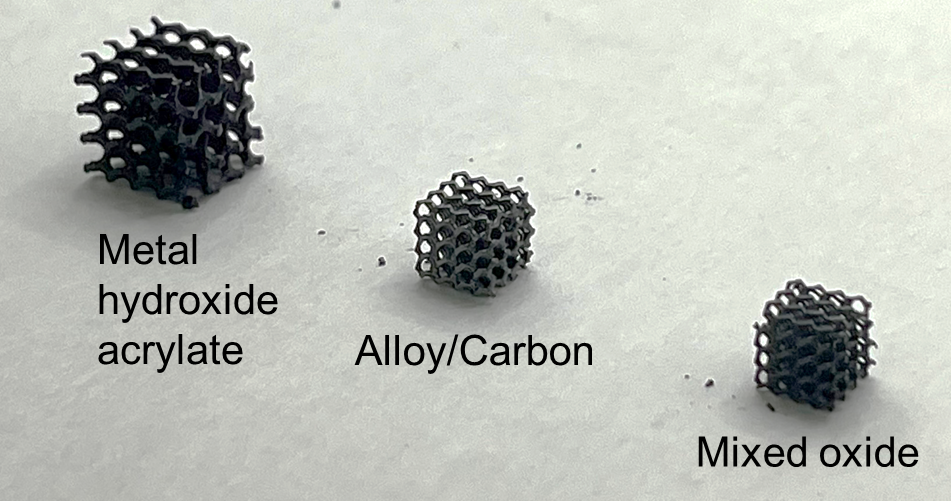
In this study, we focused on organic–inorganic hybrid nanoparticles having photoactive organic molecules on their surfaces. By concentrating their dispersions to more than several tens of times higher than ordinary concentrations, we successfully realized 3D printing of inorganic materials based on the interconnection of nanoparticles. Furthermore, we discovered that heat treatment of the printed objects under specific conditions yields structures composed of metal/carbon composites or metal oxides. By tuning the chemical composition of the precursor organic–inorganic hybrid nanoparticles, we are developing fabrication techniques that enable printing of a wider variety of materials, including metals, alloys, and ceramics.
Part of these achievements has been made through a project supported by the JKA funding program.